
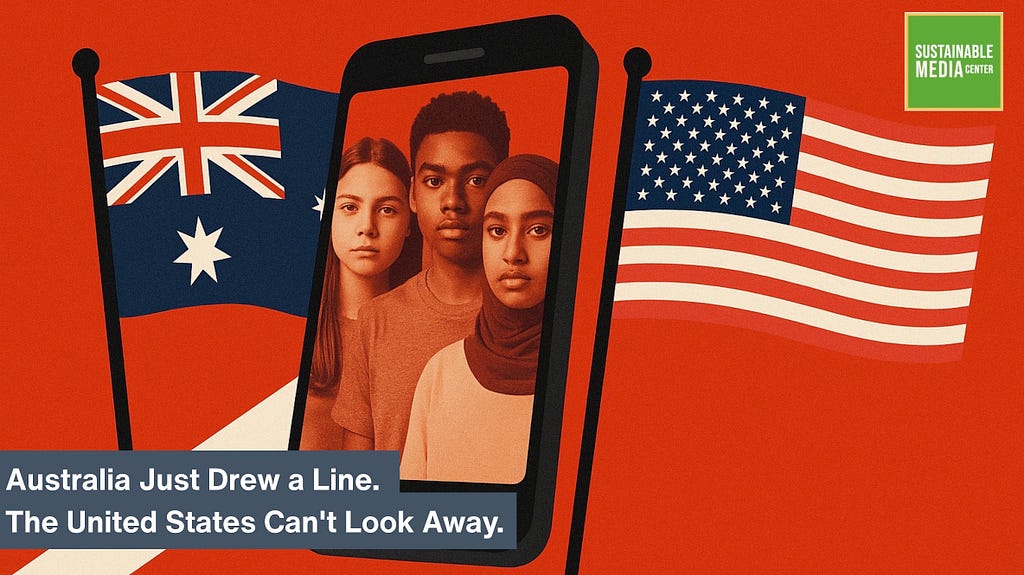
Australia did something extraordinary this week: it put children ahead of platforms. Lawmakers there banned social media accounts for anyone under 16, forcing companies to verify age or face fines that actually matter. In a world where governments tend to tinker, delay, and study the issue to death, Australia pulled the emergency brake.
You can debate whether this is the right lever. But you cannot deny its clarity.
Australia looked at skyrocketing youth anxiety, body dysmorphia, harassment, sleep loss, and suicide risk, and said: enough. No more disclaimers. No more “we’re working on safety.” A democratic society chose to protect children before optimizing engagement.
That alone should make the United States uncomfortable.
For years the U.S. pointed to KOSA — the Kids Online Safety Act — as proof that we were finally getting serious. It sailed through the Senate with a 91–3 vote, the closest we have ever come to real youth safety legislation. But it stalled in the House and was stripped of its strongest “duty of care” language. Even if it had passed, it would not have gone as far as Australia. It would have given us a backbone — a starting point — not a boundary. Australia just leapfrogged the debate and made the rules mandatory.
There are real risks in their move. Enforcement will be imperfect. Teens will find workarounds. Verification could raise privacy concerns. And banning access without building healthier alternatives can push kids toward darker corners of the digital world. Policy that protects without empowering can backfire.
Yet underneath all of that is a truth we cannot ignore: Australia treated youth harm as a public health emergency, not a brand problem. It chose action over hand-wringing.
The implications for the United States are significant.
Parents will look at this and ask, “Why aren’t we doing that?” Advocacy groups are going to cite Australia as proof that bold regulation is possible. Tech companies will fight harder, because now there is a precedent. And the policy conversation will shift from whether to regulate to how far regulation should go.
This means the pressure is moving here. Fast.
If you are part of the Sustainable Media Center community, this is the window we have been preparing for. Australia just accelerated the timeline. We need to show how youth voice, intergenerational design, certification systems, and new platform models give governments something to build toward rather than simply ban.
Australia set the floor. What we build here can be the ceiling.
The worst outcome is that America watches this moment, shrugs, and waits for Silicon Valley to adjust itself. The better path is to learn from it: regulation must come alongside innovation. Safety must be paired with agency. Parents need tools, not just prohibitions. And young people need spaces built for their wellbeing, not their extraction.
Australia took the first swing. The question now is whether the United States answers it.
As SMC friend and Advisory Board member Jonathan Haidt wrote today, Australia just took “the most monumental step yet” to protect childhood — “Bravo Australia.”


